

Building Achieve Pro from the ground up
Achieve's first B2B site for correspondent lenders — from an early brief to a launched product.
Role: Design Lead
What I worked on: Product Design, Discovery, Competitive Analysis · UX/UI, Content Direction
Partners: Product, Achieve Pro Business, Brand, Content, and Engineering
01
Achieve was entering a new B2B market with a product for correspondent lenders.
The initial brief gave us the business goal, a target audience, and a rough MVP. The public site needed to educate potential partners, explain the product, capture interest, and provide a clear path into the partner experience. It also needed to feel distinct from the consumer site. What we did not have yet was the experience itself.
There was no established information architecture, no clear product story, and no existing B2B site to build from. That was the part I needed to help figure out.
Opportunity/Problem
02
Before getting too far into layouts, I spent time understanding the space.
What does a correspondent need to see before they consider adding a new lending partner?
How quickly should they be able to understand the product?
What makes Achieve different from the lenders they already work with?
Where should the public experience stop and the partner product begin?
Those questions were not fully answered in the brief, so competitive research became part of how I filled in the gaps.
I looked at other TPO and lending experiences to understand how they structured their sites, explained their products, established credibility, and moved people toward a conversation or application.
The goal was not to copy what existed. It was to understand what this audience already expected, where competitors were doing a good job, and where Achieve needed a stronger point of view. This is a company that has been around for nearly 20 years.
Competitive research
03
PRD to prototype - AI to get something on the screen early
The brief was still open-ended, and I did not want to spend days polishing a direction before we had enough to react to.
I took the PRD, the competitive research, and the audience context into Figma Make and used it to generate early working concepts. The point was not to get a finished design. I wanted something I could push against. Once I could see the experience, I could start asking better questions.
Was the navigation helping someone understand the product?
What was missing?
What belonged on the public site versus behind login?
Did the experience give someone a reason to keep going?
Those early prototypes helped me move from requirements into information architecture and product direction much faster.
04
Early explorations
Once there was something tangible to look at, the team could start reacting to the experience rather than just a document.
Some things that looked simple in the PRD needed more thought once we could actually see them.
Content affected layout.
Research changed how we talked about the product.
Design surfaced questions that still needed product decisions.
Compliance changed language.
Engineering introduced constraints that were easier to work through once the experience was real.
My role was not just to make the screens cleaner. It was to keep the experience coherent while the product, story, content, and implementation were still moving.
05
Content + design
The PRD gave us several positioning ideas to work from, including HELOC expertise, operational responsiveness, partnership, lending credibility, and growth. That gave us useful ingredients, but it still did not tell us how the site should tell the story. The harder question was what a correspondent actually needed to understand before taking Achieve seriously as a partner.
I worked closely with Brand and Content to shape the story inside the design while the experience was still taking form.
I also wrote working copy directly into the concepts so I could evaluate whether the hierarchy and page structure actually worked with realistic content. That made content part of the design process rather than something added after the layout was finished.
06
The final experience
The finished site needed to answer a few questions quickly.
What are you offering?
Why should I consider Achieve?
What is different about this product?
Why should I trust you as a partner?
What do I do next?
That became the structure behind the final experience.
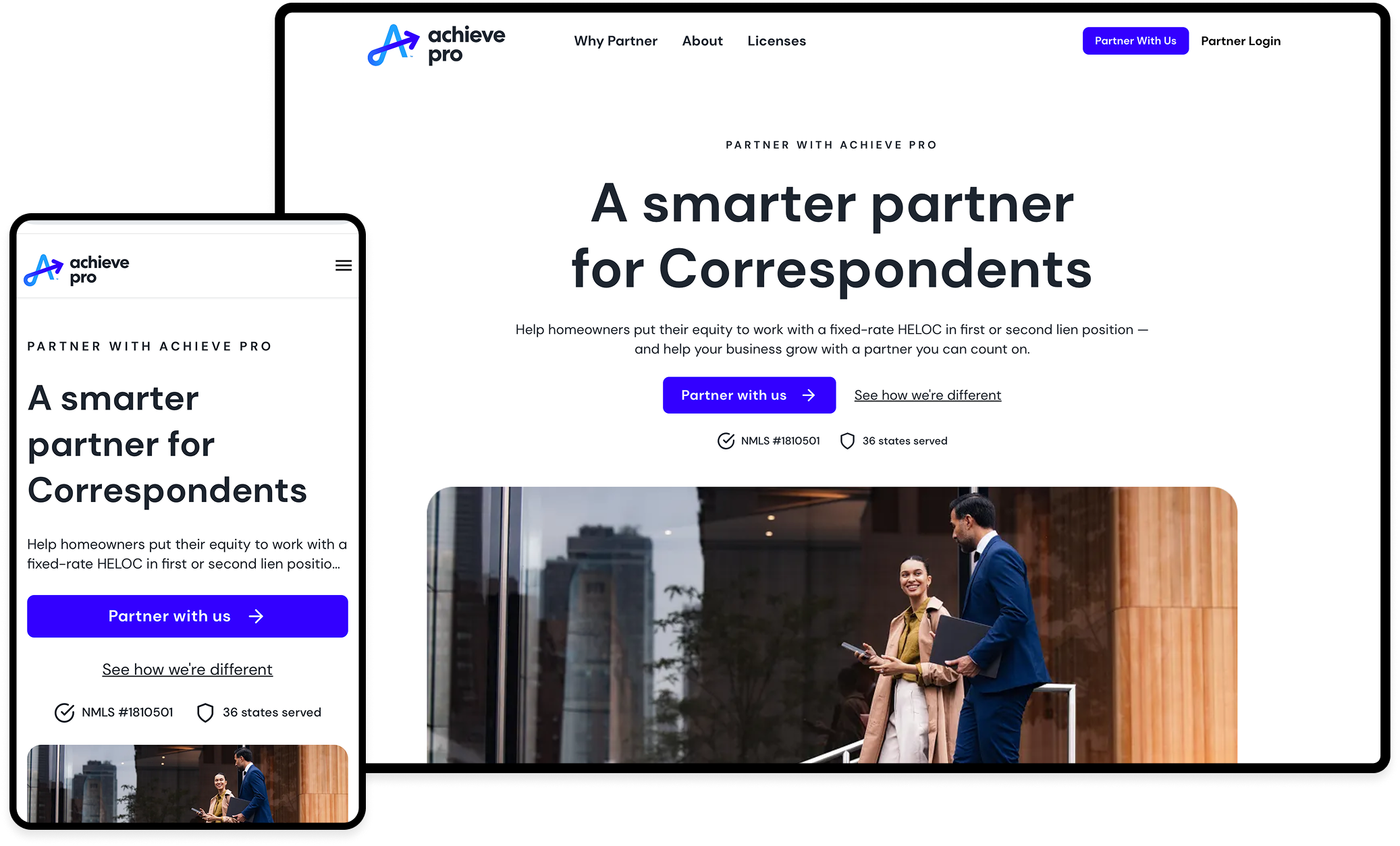
The site introduced the product, explained the value for both the correspondent and their customers, made the differentiation easier to understand, and gave people clear ways to apply, contact the team, or log into the partner experience.
It also needed to feel connected to Achieve without simply looking like another consumer product page.
07
Design to production
The design work did not end at handoff. I stayed involved with Engineering, Content, and Compliance as the experience moved into production.
There were details that needed to be resolved in the browser rather than in Figma. Responsive behavior changed. Copy changed. Compliance requirements affected specific parts of the experience. Engineering surfaced implementation questions.
I reviewed builds, worked through those decisions with the team, and made sure the final experience still felt intentional.
The project plan itself had discovery, brand, UX, and content happening in parallel, followed closely by full UI, Engineering handoff, compliance, development, and QA.
08
Launch
Achieve Pro launched in September 2026 as Achieve's first dedicated B2B experience for correspondent lenders.
What started as an early business brief became a complete acquisition experience with a product story, information architecture, content direction, and clear path into the broader partner ecosystem.
For me, the important part of the project was not just that the site launched. It was how much of the product direction became clearer through the design process itself.
09
Takeaways
I started this project with a brief that described the business opportunity, but left a lot of the experience unresolved.
That gap turned out to be the most interesting part of the work.
Competitive research helped me understand the space.
AI-assisted prototyping helped me make ideas tangible quickly.
And once there was something real to react to, the team could make better decisions about the product, the story, and what we actually needed to build.
That is probably the biggest thing I took from the project. I do not need every answer before I start designing.